
If your shoulders feel tight, heavy, or even slightly painful after a long day at your desk, you’re not alone.
For many office workers, especially those spending 6–10 hours in front of a computer, discomfort in the upper back and shoulder blade area becomes part of daily life.
But this isn’t random.
There’s a very specific reason your body reacts this way.

The Real Reason Your Shoulders Feel Tight After Sitting
When you sit for long periods, your body naturally shifts into a forward position:
Head moves slightly forward
Shoulders round inward
Upper back becomes tense
This position puts constant stress on the muscles between your shoulder blades.
Over time, these muscles:
Stay contracted
Lose circulation
Develop tight, sensitive spots
These are often referred to as trigger points.
If you’re not familiar with trigger points, you can read more here:
What Is a Trigger Point and Why It Causes Pain
Why the Shoulder Blade Area Is So Sensitive
The area between your shoulder blades is one of the most overworked parts of your body during desk work.
Unlike larger muscles, these smaller stabilizing muscles:
Work constantly to hold posture
Rarely fully relax
Build tension gradually
This is why the discomfort often feels:
Deep
Hard to reach
Difficult to stretch
Common Symptoms You Might Notice
Most people don’t describe it as “pain” at first.
Instead, it feels like:
A dull tightness between the shoulder blades
A heavy or stiff upper back
A “stuck” feeling when moving shoulders
Mild burning or fatigue late in the day
Over time, this can become more persistent.
Why Stretching Alone Often Doesn’t Work
Stretching helps but it usually isn’t enough.
That’s because:
The tension is often deep in the muscle layer
It requires targeted pressure, not just movement
This is why many people turn to tools like:
Foam rollers
Massage balls
Here’s a full comparison if you’re unsure which works better:
Massage Ball vs Foam Roller for Upper Back Pain

What Actually Helps Release Shoulder Blade Tension
To relieve this type of tension, you need two things:
1. Gentle, targeted pressure
Not aggressive, not painful just enough to release tight areas
2. Consistency
Small daily resets work better than occasional intense sessions
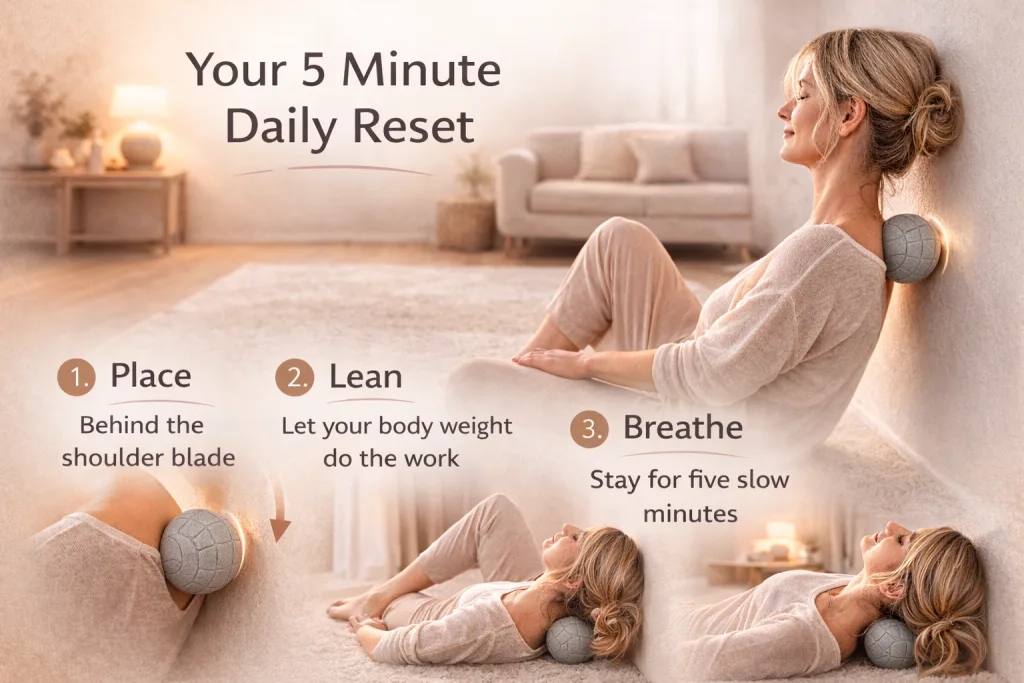
A Simple 5 Minute Reset That Works
One of the most effective ways to release shoulder blade tension is:
Place a massage ball between your upper back and a wall
Lean gently into it
Breathe slowly
Hold for 20–30 seconds per tight spot
Repeat for a few minutes. That’s it.
Why Most Massage Balls Feel Too Harsh
A common problem people run into:
Most massage balls are:
Too small
Too hard
Too aggressive
This can make the experience uncomfortable especially for beginners.
A More Balanced Approach to Pressure
For upper back tension, especially from desk work, a different kind of tool works better.
Something that:
Spreads pressure more evenly
Feels firm but not sharp
Allows you to relax into it
This is where a tool like
AcuMag Shoulder Reset fits naturally.
It’s designed specifically for:
Shoulder blade tension
Office related tightness
Gentle daily use
Instead of forcing pressure, it allows your body to gradually release.
When You’ll Start to Feel a Difference
Many people notice:
A lighter feeling in the shoulders
Less stiffness in the evening
Improved comfort during sitting
Not instantly dramatic but steadily improving.
And that’s what matters.
The Key Is Not Intensity It’s Consistency
The biggest mistake people make is trying to “fix” the problem in one session.
But shoulder tension from desk work builds over time.
So the solution should be:
Simple
Repeatable
Easy to stick with
Even just 5 minutes a day can make a noticeable difference.
Final Thoughts
Shoulder blade pain from desk work isn’t something you have to just accept.
It’s a result of:
posture
muscle tension
lack of movement
And with the right approach, it’s completely manageable.
Start small.
Stay consistent.
And give your body a chance to reset.