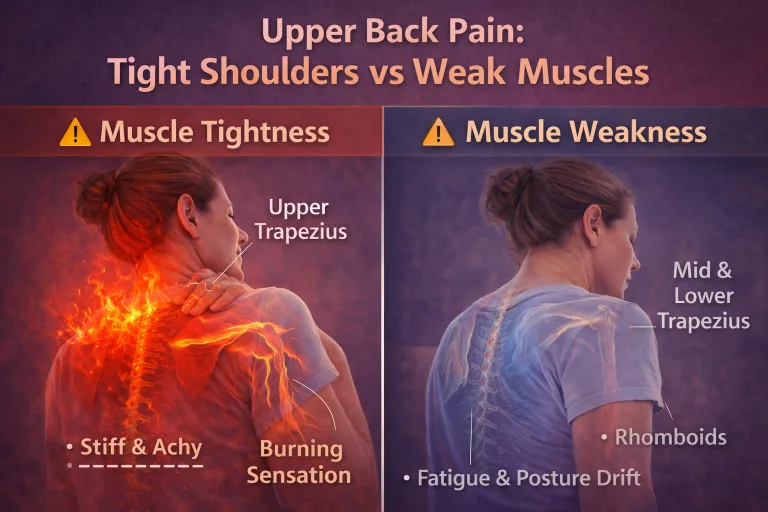
It’s not sharp.
It’s not stabbing.
It’s not exactly muscle soreness either.
It feels… hot.
A burning sensation between your shoulder blades can be uncomfortable and sometimes worrying.
But in most cases, it’s not a serious condition.
It’s a signal.
Let’s break down what’s actually happening.
Why Does It Feel Like Burning Instead of Tightness?
Most people expect muscle tension to feel stiff or sore.
But when tension becomes chronic, the sensation can change.
A burning feeling often means:
Local muscle fatigue
Reduced circulation
Trigger point irritation
Mild nerve sensitivity
When muscles stay contracted for long periods especially in the upper back they compress tiny blood vessels.
Less blood flow means less oxygen.
And low oxygen in muscle tissue can create a warm, burning sensation.

The Most Common Cause: Prolonged Shoulder Elevation
Think about your day.
When you:
Work at a desk
Look at your phone
Drive for long periods
Sit under stress
Your shoulders subtly lift and tighten.
Even a small elevation held for hours strains the upper trapezius and rhomboid muscles.
Over time, this creates:
Localized fatigue
Tissue sensitivity
Burning between the shoulder blades
If you spend long hours sitting, you may also want to read:
Why Your Shoulders Feel Tight After Desk Work
Trigger Points Can Create Burning Pain
Trigger points are small hyper irritable spots within tight muscle bands.
When activated, they can cause:
Deep aching
Warmth
Referred discomfort
A burning sensation
The area between the shoulder blades is a common trigger point zone.
You can learn more in:
The Real Reason Your Shoulder Knots Keep Coming Back
Stress Can Amplify the Sensation
Stress increases nervous system activity.
When the nervous system stays activated:
Muscle tone increases
Pain sensitivity rises
Burning sensations feel more intense
Even if the structural issue is mild.
For a deeper explanation, see:
How Stress and Your Nervous System Create Chronic Shoulder Tension
When Is Burning a Red Flag?
Most burning between the shoulder blades is muscular.
However, seek medical care if you experience:
Numbness
Tingling in arms
Weakness
Radiating pain
Chest pain
Sudden severe symptoms
Those patterns require evaluation.
But dull, warm, persistent burning that worsens with posture or stress is usually muscular tension.
Why It Often Gets Worse at Night
Many people notice:
“It’s not that bad during the day but at night it burns.”
That’s because:
You stop moving
Awareness increases
Muscle guarding becomes noticeable
Inflammation peaks slightly in the evening
This does not mean damage is worsening.
It means your body is no longer distracted.
How to Reduce Burning Between the Shoulder Blades
The goal is not aggressive stretching.
The goal is restoring circulation and reducing muscle guarding.
1. Gentle Shoulder Drops
Throughout the day:
Lift shoulders slightly
Slowly release
Exhale fully
Repeat several times.
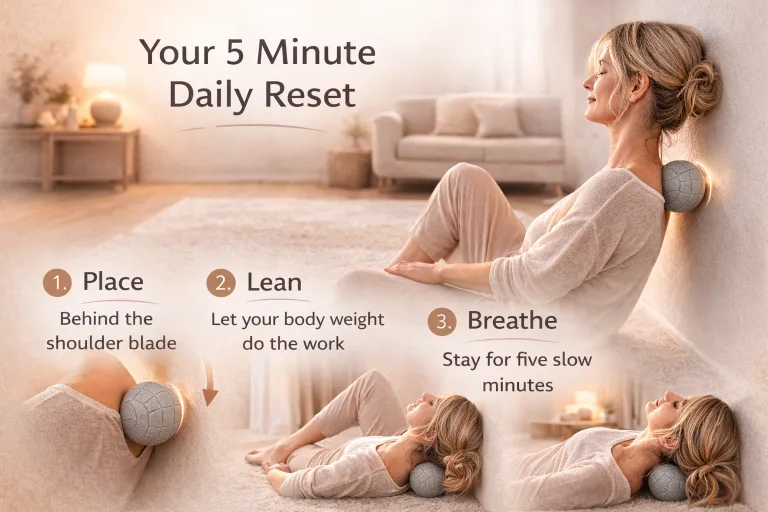
2. Wall Based Decompression
Leaning gently against a wall with controlled pressure can help release localized tension.
Consistency matters more than force.
Short daily sessions prevent accumulation.
For daily upper back tension:
For deeper, long standing tightness:
3. Breathing Reset
Inhale for 4 seconds.
Exhale for 6 seconds.
Longer exhalation calms the nervous system and reduces muscle guarding.

The Real Takeaway
A burning sensation between your shoulder blades is usually not damage.
It’s accumulated muscle fatigue combined with stress and reduced circulation.
When tension becomes chronic, the sensation changes.
But the solution is steady, controlled decompression not panic.
With the right daily support, that burning feeling becomes manageable again.